
Every scaling organization faces the same frustrating paradox: You’ve hired the best people from the best schools with the most impressive resumes, yet the “needle” isn’t moving as fast as it should. Your team is busy—exhausted, even—but the actual progress toward your North Star feels sluggish.
The reason is a fundamental misunderstanding of what makes a team “good.” Most leaders hire for Magnitude, but the winners of the next decade will hire for Velocity.
The Magnitude Trap
In traditional talent acquisition, we treat “talent” as a static, measurable volume. We look at years of experience, technical certifications, and past titles. This is Magnitude. It tells you how much “engine” a person has, but it tells you absolutely nothing about which way that engine is pointed.
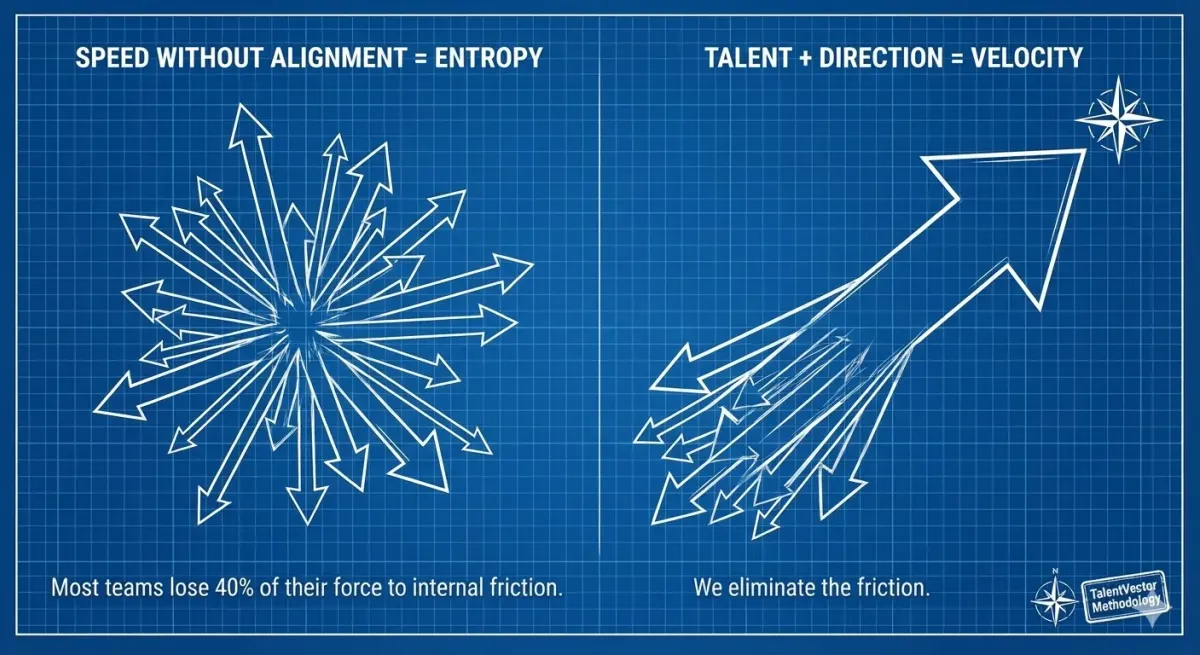
When you stack an organization with high-magnitude individuals who lack a unified direction, you don’t get a powerhouse; you get Entropy. Each individual pulls toward their own version of “excellence,” creating internal friction that eats your productivity for breakfast.
Why Velocity is the Only Metric That Matters
In physics, velocity is defined as Speed with a Direction. In a business context, Velocity is Skill with Alignment.
- Speed (Magnitude): Gets you from point A to point B, but without a compass, you might be sprinting toward the wrong “B.”
- Velocity (Magnitude + Direction): Ensures that every ounce of effort your team expends is additive, moving the entire organization toward the same destination.
Hiring for velocity means looking past the resume to understand the human vector: Does this person’s natural intent, professional goals, and working style align with your specific mission and team dynamics?
The Business Case for Alignment
Ignoring “direction” is a silent killer of innovation. High-magnitude individuals who aren’t aligned don’t just “fail to help”—they actively create drag. They reinvent wheels, misinterpret goals, and inadvertently work at cross-purposes with other departments.
When you solve for Velocity, you realize:
- Efficiency Gains: You no longer need to micromanage because the “compass” is built into the hire.
- Reduced Friction: Decisions happen faster when everyone is working from the same directional map.
- Maximum ROI: You get the full value of the high-cost skills you’ve recruited because they are actually being applied to the problem at hand.
Stop Measuring Potential, Start Measuring Force
It is time to stop viewing human capital as a static asset on a balance sheet and start viewing it as a dynamic force. Are you building a team that is merely “talented,” or one that is aligned?
If you want to stop gyrating in place and start accelerating, you must shift your framework from Magnitude to Velocity.