
Right now, somewhere inside your applicant tracking system, a candidate who could have done the job is being moved into the rejection pile.
They aren’t being rejected because they lack the capability. They’re being rejected because nobody actually measured it.
That gap — between what hiring decisions are supposed to evaluate and what they actually evaluate — is the single most expensive blind spot in enterprise talent acquisition. And it’s hiding in plain sight inside the most expensive process most companies run.
The interview is not a measurement instrument
The dominant tool in enterprise hiring is the unstructured interview, and it has been studied for decades. The verdict has been remarkably consistent.
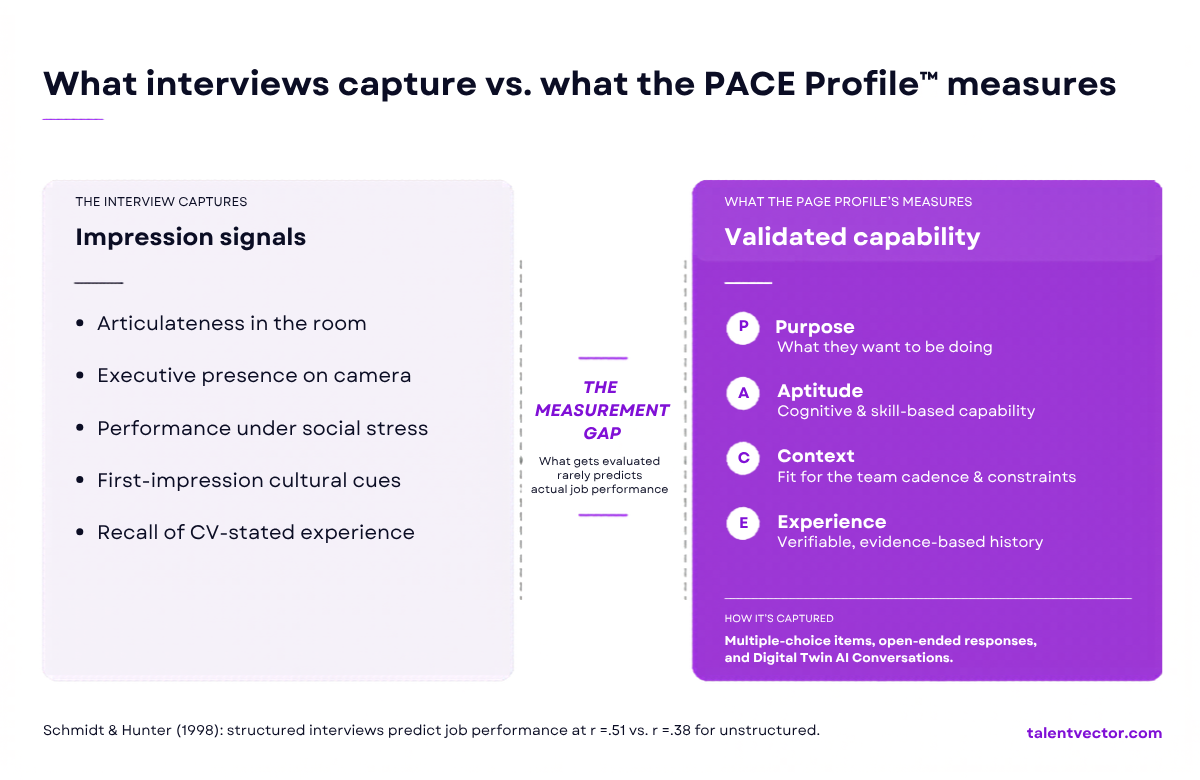
Schmidt and Hunter’s landmark 1998 meta-analysis in Psychological Bulletin — synthesizing 85 years of personnel selection research — found that unstructured interviews predict on-the-job performance with a validity coefficient of approximately 0.38. Structured interviews come in at roughly 0.51, a meaningful gap that has been replicated across subsequent reviews (Schmidt & Hunter, 1998; summarized in Cogn-IQ, 2025).
Translated out of statistics: the format most enterprises still rely on for the most consequential conversations in hiring is, at best, modestly correlated with the outcome it claims to predict. Yet most hiring panels treat the interview as the decisive moment — the place where the offer is made or withheld.
What’s actually being measured in those rooms is rarely what the role demands. It’s articulateness, executive presence, social fluency, and whatever proxies a fatigued interviewer happens to anchor on after their fifth back-to-back call.
The signal is the wrong shape
Even when an interview goes well, what it captures is one specific thing: how a candidate performs under the very particular stress of being evaluated by strangers in real time.
That’s a real signal. It just isn’t the signal most jobs actually require.
A senior data engineer is not paid to perform under conference-room pressure. A clinical operations leader is not paid for executive presence in a 45-minute window. Most roles are paid for sustained capability under the conditions of the actual job — conditions that look almost nothing like an interview.
This is the conflation at the heart of the problem. We’ve spent decades treating interview performance as a proxy for job performance, even when the predictive evidence has consistently said it isn’t. The candidate who interviews well gets the offer. The candidate who would have done the work better — but interviews unevenly — gets the rejection email.
What the wrong signal costs
The financial picture is no longer ambiguous.
The U.S. Department of Labor estimates that a single bad hire costs at minimum 30% of the role’s first-year compensation. SHRM’s 2025 Benchmarking Report places the all-in replacement cost between 50% and 200% of annual salary, with executive recruitment alone averaging $35,879 in direct cost — up roughly 21% from 2022 (SHRM 2025 Benchmarking Report, summarized by Pin, 2026).
But the harder cost is the one that never appears on a P&L: the capable candidates turned away. Every one of those rejections is a foregone hire — capability that walked out of your funnel and into a competitor’s offer letter.
The capability gap is a measurement problem, not a people problem
There is nothing inherently wrong with the interviewers. There is nothing inherently wrong with the candidates. The problem is structural: the dominant evaluation method isn’t designed to measure what hiring decisions are actually deciding.
A defensible hiring decision needs evidence on four questions:
- Purpose. What kind of work does this person actually want to be doing, and does that orientation match the role?
- Aptitude. Can they actually do the cognitive and skill-based work the role requires?
- Context. Will their capability hold up under the specific operating conditions — the team, the cadence, the constraints?
- Experience. What have they actually done — verifiable, not asserted — that maps to what we need them to do here?
These four are the dimensions of TalentVector’s PACE™ framework, and together they make up the PACE Profile™ — the multi-dimensional capability picture a hiring committee can actually defend.
Most interviews don’t attempt to answer these four questions in any structured form. They sample for impression and justify the impression after the fact. That isn’t measurement. It’s pattern matching.
What validated hiring looks like
The shift TalentVector’s HireVector module is built around is simple to state and harder to operationalize: stop inferring capability and start measuring it.
In practice, that means structured assessments generated from the actual job context — not generic competency batteries. It means a layered elicitation method — multiple-choice items, open-ended responses, and standardized Digital Twin AI Conversations — designed to surface signal across all four PACE dimensions, including the Purpose signal that traditional interviews almost never capture. It means a complete PACE Profile™ per candidate that a hiring committee can defend on the evidence rather than the vibe.
This is what the category is increasingly calling validated talent intelligence: glass-box, evidence-based capability decisions replacing black-box pattern matching. In a hiring environment where the cost of a single wrong call now runs into six figures, that is no longer an aspirational position to hold.
The candidate isn’t the problem
The candidate being rejected right now isn’t the problem. The fact that nobody measured what they’re being rejected for — that’s the problem.
If your hiring decisions deserve evidence rather than impressions, see what TalentVector measures, how the PACE Profile™ is constructed, and why enterprise teams evaluating the platform call it the missing foundation layer of modern talent acquisition.
See the platform in action: linkly.link/2hxz5
Sources cited: Schmidt & Hunter, “The validity and utility of selection methods in personnel psychology,” Psychological Bulletin (1998); U.S. Department of Labor; SHRM 2025 Benchmarking Report.