
The Paradox Nobody Wants to Admit
Your recruiting budget just hit an all-time high. Your L&D team delivered record training hours. Your job postings list requirements that read like a technical Ph.D. dissertation.
And yet — productivity is stalling. Key initiatives are missing their mark. Turnover is climbing despite the investment.
The conventional diagnosis? “We have a skill gap.”
The conventional solution? More certifications. More boot camps. More “elite” hires.
The actual problem? You are treating a compass problem like a horsepower problem.
The Skill Gap Is a Convenient Distraction
The “Skill Gap” narrative has become the default explanation for organizational underperformance — and it’s an expensive one. U.S. companies spend over $100 billion annually on corporate training. Research on the Ebbinghaus Forgetting Curve shows that without reinforcement, employees forget up to 90% of newly learned material within a week. At TalentVector, we’d argue the deeper reason is an alignment problem — skills that aren’t pointed at a relevant mission don’t get reinforced, applied, or retained. The upshot is that most skills learned in formal training evaporate within weeks because the environment and direction weren’t aligned with the learning in the first place.
The Skill Gap is not a myth because skills don’t matter. Skills absolutely matter. The Skill Gap is a myth because adding skills to a misdirected team doesn’t fix the direction. It just makes the wrong journey faster and more expensive.
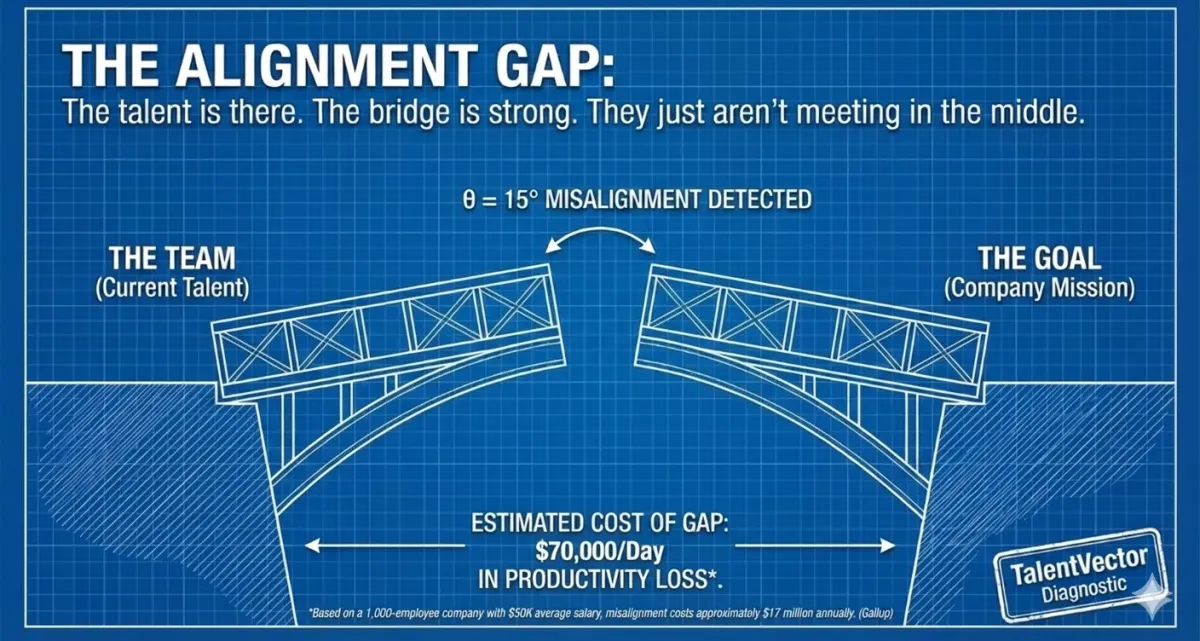
When you build a bridge section by section, each piece must connect and align with the one before it. Adding more bricks — more certifications, more headcount, more tools — to a bridge that’s pointing the wrong way doesn’t get you to the other side. It just makes the mistake more costly to reverse.
The Real Problem: The Alignment Gap
The Alignment Gap is the distance between where your team’s individual vectors are pointing and where your organization’s North Star actually is.
Unlike the Skill Gap, the Alignment Gap doesn’t show up on a resume. It doesn’t appear in a certification list or a LinkedIn profile. It lives in the invisible space between what a person can do and what they are motivated to do — in your specific context, on your specific mission, within your specific team dynamics.
When even one or two high-magnitude players on your team are misaligned in direction, the drag they create isn’t zero. It’s multiplicative. They reinterpret goals. They optimize for their own version of “excellent.” They inadvertently pull resources and attention away from the team’s true heading.
The Vector Alignment Map™: A New Diagnostic for a New Era
Solving the Alignment Gap requires a different kind of tool — not a skills assessment, but a directional diagnostic.
At TalentVector, we developed the Vector Alignment Map™ — a three-step framework for identifying and closing Alignment Gaps before they become organizational drag:
- Plot — Map each team member’s individual vector: their skill magnitude and their directional intent. Where are they naturally pointed? What does “winning” look like from their perspective?
- Compare — Measure the divergence between each individual vector and your organization’s stated North Star. How wide is the gap? Where is the friction greatest?
- Redirect — Before investing in new skills, new hires, or new tools, realign or redeploy the talent you already have. The delta between “misaligned” and “aligned” is often worth more than your next hire.
The math here is not subtle. Force is not just magnitude. It is magnitude times direction. Gallup’s research consistently shows that highly engaged teams — those where people understand the mission and feel connected to it (aka Alignment) — produce 23% higher profitability than their disengaged counterparts. At TalentVector, we’d call that the alignment premium. And it has nothing to do with credentials.
The Business Case for Closing the Alignment Gap First
When organizations solve for Alignment before Skill, three things happen reliably:
- Decision velocity increases. When everyone is working from the same directional map, fewer decisions require escalation, negotiation, or re-explanation. The compass is built into the culture.
- Training ROI multiplies. Skills taught to an aligned team compound. Each new capability accelerates the shared mission instead of getting lost in individual interpretation.
- Turnover drops — for the right reasons. Aligned employees don’t just stay longer; they stay purposefully. They are not just employed. They are engaged in a direction that resonates with their own professional vector.
Stop Buying Bricks. Start Drawing the Map.
The organizations that will outperform in the next decade are not the ones with the most certifications on paper. They are the ones that figure out — before they spend — whether their talent is moving in the same direction.
The question is not “Do we have the right skills?”
The question is: “Are we all heading to the same place?”